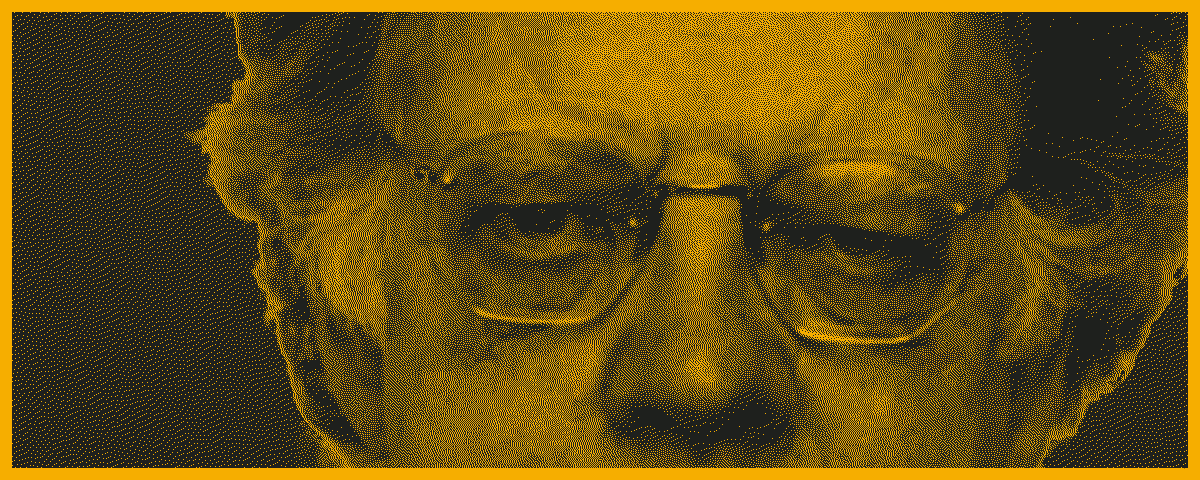
Northrop Frye
I listened to a podcast on St. Augustine’s City of God the other day, and then went on Youtube to look for further explanations. To figure out what I just listened to. I got bored of searching, and decided to find a lecture on literary criticism instead.
There was this Canadian theorist I heard about on the Ken and Robin talk about stuff podcast, but I couldn’t remember his name. Some weird name. Bought a book of his at one point. Well, good thing we have ChatGPT (bleurgh). Because that slop machine immediately told me that I must be thinking of Northrop Frye.
And I was. And I searched. And there are several videos on Youtube explaining the literary scientist’s writings. And not just that. There’s an entire lecture online featuring the man himself, concerning his study of the bible, called Northrop Frye - The Bible and English Literature.
I watched the first unit, 45 minutes. It’s good. Not that hard to understand. You can even read along if you buy his book, The Great Code - The Bible and Literature. Here’s an excerpt:
Those who do succeed in reading the Bible from beginning to end will discover that at least it has a beginning and an end, and some traces of a total structure. It begins where time begins, with the creation of the world; it ends where time ends, with the Apocalypse, and it surveys human history in between, or the aspect of history it is interested in, under the symbolic names of Adam and Israel.
There is also a body of concrete images: city, mountain, river, garden, tree, oil, fountain, bread, wine, bride, sheep, and many others, which recur so often that they clearly indicate some kind of unifying principle. That unifying principle, for a critic, would have to be one of shape rather than meaning; or, more accurately, no book can have a coherent meaning unless there is some coherence in its shape. So the course turned into a presentation of a unified structure of narrative and imagery in the Bible, and this forms the core of the present book.
